
Should You Use AI to Design Your Garden?
Artificial intelligence tools like ChatGPT, Google’s Gemini, and other AI platforms have revolutionized how we access information. It’s no surprise that home gardeners are turning to these tools for help designing their gardens. AI can generate plant lists in seconds, suggest layout ideas, and provide general growing information – all at the click of a button.
As someone who’s been designing gardens for 20 years, I think AI can be a valuable starting point for research. But recently, I’ve been seeing the limitations play out in real gardens – and the gap between theoretical information and on-the-ground reality.
When AI Falls Short: A Real Example
A client came to me this summer after using AI to design her garden. She had a newly constructed home with a backyard planting area along the fence – approximately 2 feet wide by 30 feet long, facing east. She told AI it received 6-8 hours of sun during summer.
She loves fragrant, white-flowering plants, so she asked AI for scented, white-flowering varieties suitable for full sun. AI delivered exactly what she requested: a list of fragrant white-flowering perennials, shrubs, and groundcovers, complete with accurate growing information. She created a layout and had the plants planted.
Then reality hit.
After the plants were in the ground, she realized the high retaining wall above the planting area cast significant shadows. Her “full sun” location actually only received about 4 hours of direct sun, and only after mid-day. The taller plants could eventually reach the sun, but their roots and the shorter shrubs remained in shade most of the day.
The soil told another story. This was a newly constructed home and the “soil” was actually hard, clay-like material packed with rocks, plus concrete remnants from construction. Every plant installation required removing native soil and amending heavily with new soil and compost, just to give plants a fighting chance.
And those beautiful white-flowering, fragrant shrubs AI recommended? Many would mature at 8-10 feet wide – completely overwhelming a 2-foot-wide planting strip and eventually spilling out into their patio, encroaching on what little useable space they did have and and making their small yard feel even more cramped.
Here’s the thing: AI gave her technically accurate information. The plants really were white-flowering and fragrant. They really did prefer full sun. The mature sizes were correctly listed. The hardiness zones were right.
But AI was working with the information she provided: “15×30 foot area, east-facing, 6-8 hours sun.” It couldn’t see the retaining wall. It couldn’t assess the shadow patterns throughout the day. It couldn’t dig into that rocky concrete-filled clay soil. It couldn’t stand there and visualize what “8 feet wide” actually means in a 2-foot-wide space.
As a self-described gardening beginner, she didn’t know what information was important to share or what questions to ask – either of AI or of herself when planning the garden.
This is the fundamental limitation: AI provides information, but gardens exist in physical reality. And reality is almost always more complicated than the description we give AI.
What AI Can Do Well
Let’s be fair – AI tools have genuine strengths for garden planning:
- Generate plant lists quickly based on criteria like sun exposure, height, or fragrance
- Provide accurate growing information about water needs, hardiness zones, and general care
- Suggest design principles like layering, repetition, and focal points
- Offer inspiration from countless garden styles and approaches
- Answer specific factual questions about plant families, bloom times, or botanical names
- Ask clarifying questions to help you think through your needs
For someone just starting to explore gardening or gathering initial ideas, AI is genuinely helpful.
What AI Misses Every Time
Here’s where technology hits its limits – and where hands-on, local expertise becomes invaluable:
Actually Seeing Your Space
This cannot be overstated. AI works with descriptions and measurements, but descriptions are inherently limited. My client described 6-8 hours of sun – which was true in summer before she noticed the shadow patterns. She couldn’t have known to mention the retaining wall’s shadow impact until she saw it happen.
I would have visited the site, looked at that retaining wall, and immediately flagged the shadow issue. I would have seen the 2-foot width and known we needed compact plants, not 8-foot shrubs. Spatial awareness requires being there.
Hidden Site Conditions
That construction-debris-filled clay soil? You don’t discover that until you dig. But with experience, I can look at a newly built home and anticipate difficult soil conditions. I know what questions to ask about construction timeline, soil amendments, and drainage that most homeowners don’t think to mention.
Shadow Patterns and Microclimate
Sun exposure changes dramatically throughout the year and throughout the day. Understanding how a retaining wall, fence, neighboring trees, or structures cast shadows requires either living with the space for a full year or having the experience to visualize it. AI can’t do either.
Local Growing Conditions
AI might recommend plants that technically grow in Zone 8, but that doesn’t mean they’ll thrive in our Pacific Northwest maritime climate with cool, wet winters and dry summers. Some plants love “Zone 8” in hot, humid conditions – completely wrong for our region. And post-construction clay soil with poor drainage? That requires specific plant selection that only someone with experience provides.
Mature Plant Sizes in Real Context
AI will tell you accurate mature dimensions, but it can’t visualize how that fits your actual space. An 8-foot-wide shrub in a 2-foot-wide planting strip isn’t just “a bit cramped” – it’s a fundamental design failure that will create maintenance headaches and eventually require removal. I can see that immediately; AI cannot.
Multi-Seasonal Design for Challenging Sites
My client’s garden faces multiple challenges: limited sun, difficult soil, narrow planting space. Designing for year-round interest under these constraints requires experience juggling multiple factors simultaneously – bloom times, mature sizes, shade tolerance, soil adaptability, and visual flow. AI can address each factor individually, but integrated problem-solving is a different skill.
Problem-Solving Real Challenges
Here’s what I would have recommended for my client who wanted white flowers and fragrance in a challenging 2-foot-wide, part-shade planting strip: shade-tolerant evergreen fragrant plants like sarcococca (sweetbox) with its tiny white winter blooms and incredible scent, and compact white-flowered rhododendrons or azaleas that stay under 3 feet. For herbaceous interest, white-flowered hellebores for late winter, white astilbes for summer bloom and texture, and perhaps some white bleeding hearts (Dicentra spectabilis ‘Alba’) for spring. The evergreen backbone provides year-round structure while the perennials add seasonal white blooms.
All of these stay compact enough for a 2-foot space, tolerate less-than-ideal sun and difficult soil, and create white flowers, fragrance, and multi-seasonal interest with evergreen structure – exactly what she wanted, but actually achievable in her real conditions.
That recommendation requires understanding Pacific Northwest plants, visualizing the space, anticipating the soil challenges, and designing around the limitations. It’s integrated problem-solving that AI simply can’t replicate.
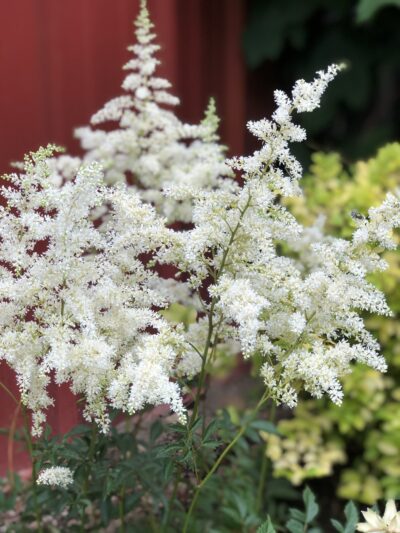
Astilbe arendsii ‘Bridal Veil’
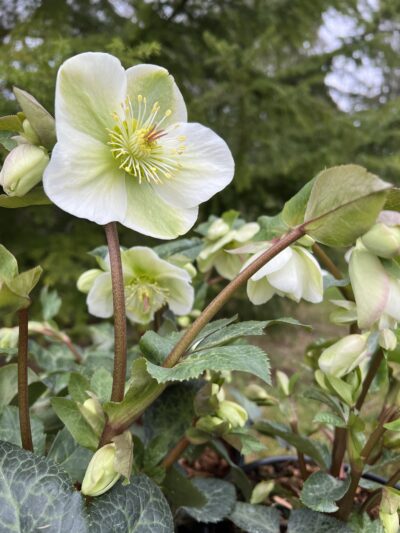
Helleborus Frostkiss® ‘Molly’s White’
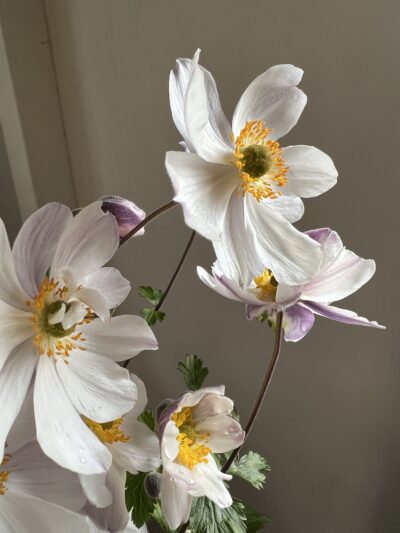
Anemone ‘Elfin Swan’
Long-Term Performance Reality
I’ve watched thousands of plants grow (and sometimes struggle) in Pacific Northwest gardens over 20 years, including many newly constructed homes with challenging soil. I know which plants actually tolerate our particular brand of clay soil, which ones adapt to inconsistent sun, and which “compact” varieties actually stay compact versus those that outgrow their space despite catalog descriptions.
The Sweet Spot: Technology Plus Experience
Here’s what I actually recommend: Use AI as a research and brainstorming tool, then work with someone who can assess your actual site.
Start with AI to:
- Explore plant options and gather ideas
- Learn basic terminology and concepts
- Understand general growing requirements
- Get inspired by different garden styles
- Create an initial wish list of features you want
Then work with a local professional to:
- Actually visit and assess your specific site conditions
- Identify challenges you might not see (shadow patterns, drainage issues, soil problems)
- Select plants that will thrive in YOUR garden’s reality, not the theoretical description
- Design for multi-seasonal interest within your site’s constraints
- Ensure proper spacing for mature sizes in your actual space
- Problem-solve difficult conditions based on experience
- Source plants that are proven performers in our region
Think of it this way: AI is like having access to every gardening book and database ever created. That’s valuable for learning! But a professional brings something AI never can – the ability to stand in your actual space on a cloudy November day, look at that retaining wall, dig a test hole in your soil, and say “here’s what will actually work here.”
Winter: The Perfect Time for Site Assessment
If you’re thinking about a garden transformation, winter is actually ideal for planning. Deciduous trees are bare, so you can clearly see light patterns and structures. The ground is often workable for test holes to assess soil. You can see where there are “holes” in beds and borders, and there’s no rush to plant, which means time to think strategically and solve problems before they become expensive mistakes.
This is when thoughtful design happens – not in the spring panic of “I need to plant something NOW,” but in the calm analysis of understanding your site’s reality and planning for long-term success.
Ready to Create a Garden That Actually Thrives?
I offer garden and plantscaping consultations where I’ll visit your property, assess your actual site conditions (sun, shade, soil, space, challenges), and create a custom plant palette that will thrive in your specific reality. Every plant is selected by me, either directly from my nursery or from other nurseries that also source regionally appropriate varieties that I know perform well in Pacific Northwest conditions – including the difficult ones.
Interested in learning more? Visit sublimegardens.com or reach out at info@sublimegardens.com to schedule your consultation.
Have you tried using AI for garden planning? I’d love to hear about your experience – what worked and what surprised you when reality met the plan. Share your story in the comments below.






Leave A Comment